
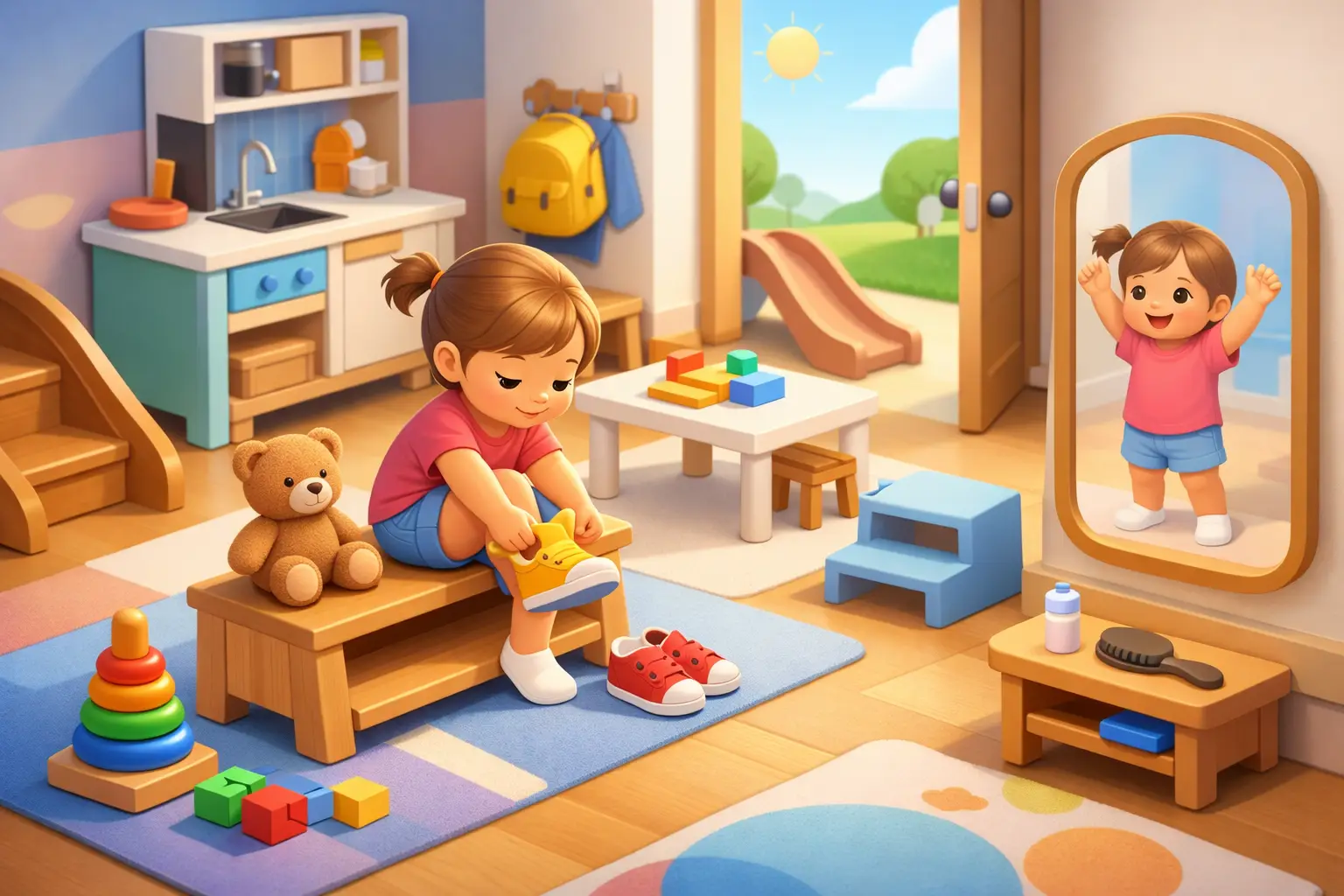
A toddler standing at the door with one shoe on, insisting, “Me do it,” can make a rushed morning feel much longer. Yet these small moments are exactly where confidence begins. Helping toddlers build independence is not about expecting them to manage alone. It is about giving them safe, age-appropriate chances to try, make choices, and feel proud of what they can do.
For young children, independence grows through warm encouragement, familiar routines, and plenty of time to practice. A child who learns to put a cup in the sink, choose between two shirts, or help pack away toys is learning far more than a task. They are building the belief that their actions matter.
What independence looks like for toddlers
Toddler independence rarely looks neat or efficient at first. It may mean a child trying to feed themselves and dropping some food, attempting to pull up a zipper, or wanting to climb into their car seat before asking for help. These efforts support physical coordination, communication, problem-solving, and emotional resilience.
The right expectation depends on a child’s age, temperament, and experience. Some toddlers are ready to try everything; others prefer to watch carefully before joining in. Neither approach is wrong. The goal is steady progress, not comparison with another child.
At this stage, independence often includes simple self-care, such as washing hands with support, helping with dressing, using a spoon, and putting belongings in a familiar place. It also includes social skills: taking a turn, asking for help, choosing an activity, and coping with a small disappointment.
Helping toddlers build independence at home
Home is a child’s first place to practice being capable. The most helpful approach is to make everyday routines accessible rather than adding a long list of new jobs. A toddler does not need a complicated responsibility chart. They need a few repeated opportunities that feel meaningful.
Create routines your child can predict
Children feel safer when they know what comes next. A simple morning rhythm, such as getting dressed, eating breakfast, brushing teeth, and putting on shoes, gives toddlers a chance to participate in the same sequence every day. At bedtime, they may help choose pajamas, place a book beside the bed, or put dirty clothes in a basket.
Keep instructions short and specific. Instead of saying, “Get ready,” try, “Please put your socks in the drawer.” One step at a time helps a toddler succeed without becoming overwhelmed. As they become more familiar with the routine, you can gradually offer less help.
Make small choices available
Choices give toddlers a healthy sense of control, especially at an age when much of their day is decided for them. Offer two acceptable options: “Would you like the blue cup or the yellow cup?” or “Do you want to walk to the bathroom or hop like a bunny?”
Avoid choices when there is not really a choice. If it is time to leave, asking, “Do you want to go now?” may invite a frustrating battle. Instead, offer choice within the boundary: “It is time to go. Would you like to hold my hand or carry your water bottle?”
Set up the environment for success
A child-sized stool by the sink, low hooks for a bag or jacket, and a basket for toys can make independence easier. When children can reach what they need safely, they are more likely to take part in daily routines without constant adult direction.
You do not need to change every room. Start with one area that causes regular stress, such as the entryway or bathroom. A small change can turn “I can’t” into “I’ll try.”
Allow time for practice
Toddlers learn by doing slowly, repeatedly, and imperfectly. If every adult takes over because it is faster, children miss the practice that leads to real confidence. When possible, begin routines a few minutes earlier so your child can attempt the zipper, spoon, or shoe before you step in.
Support does not mean doing everything for them. You might start a zipper and let your child pull it up, hold the bowl steady while they scoop, or place one arm into a shirt sleeve and let them find the other. This is often called “just enough help,” and it protects a child from frustration while keeping the achievement theirs.
Encourage effort without pressure
Praise is most helpful when it notices a child’s effort and process. Rather than saying only, “Good job,” try, “You kept trying until the block fit,” or “You put your shoes by the door all by yourself.” Specific words help children understand what they did well.
It also helps to stay calm when attempts do not work. A spilled drink or a mismatched sock is not a failure. You can say, “The water spilled. Let’s get a cloth and clean it together.” This teaches responsibility without shame and shows that mistakes are manageable.
There are times when adults should take the lead. A tired, hungry, ill, or overstimulated toddler may not be ready to practice a new skill. Safety always comes first, particularly around stairs, water, food preparation, and parking areas. Independence should feel secure, never like a test a child has to pass.
Independence grows through play
Play is one of the most natural ways for toddlers to practice being capable. Pretend play lets them care for a doll, prepare a toy meal, or tidy a small play space. Building with blocks develops patience and planning. Simple puzzles, play dough, drawing, and threading large beads strengthen the hand control needed for dressing, feeding, and early writing.
Active play matters too. Climbing, balancing, carrying light objects, and moving through a safe obstacle course help toddlers understand what their bodies can do. When educators and parents offer gentle encouragement instead of immediately rescuing a child from every challenge, children learn to assess risk and try again.
A play-based early learning environment also offers children the chance to make choices alongside peers. They may select an activity, help distribute materials, wait for a turn, or join a group cleanup. These everyday experiences build independence while children remain supported by caring adults.
How preschool supports confident, capable children
For many families, preschool adds a valuable layer of consistency. Children see that familiar routines happen outside the home too: washing hands before meals, putting toys away after play, sitting together for a story, and caring for shared spaces. They also observe other children trying new things, which can be a powerful source of motivation.
In a nurturing classroom, educators watch closely for what each child can do independently and where they need support. A child may be confident with feeding but hesitant about speaking in a group. Another may enjoy choosing activities but need help with transitions. Thoughtful guidance meets children where they are instead of pushing every child at the same pace.
At CESK Pre-school, age-appropriate learning through play helps children develop social, communication, physical, and self-help skills in a safe, home-like setting. For toddlers, the aim is not perfection. It is the growing confidence to say, “I can try,” while knowing a trusted adult is nearby.
When a toddler resists doing things alone
Resistance is normal, even after a child has mastered a skill. Toddlers often seek extra help during changes at home, busy weeks, illness, travel, or the arrival of a sibling. Asking to be carried or wanting a parent to do a familiar task can be a request for connection, not a sign that independence has disappeared.
Try reconnecting before redirecting. A brief cuddle, a calm voice, or doing the first step together can help. You can say, “I know you want help. I will help you start, then you can finish.” This keeps the boundary gentle and gives your child a path back to success.
Avoid turning independence into a power struggle. If your toddler refuses to put on shoes, it may help to offer the two-shoe choice, make it part of a playful race, or simply assist when time is tight and try again later. Consistency matters more than winning one difficult moment.
The small tasks your toddler practices today may take patience, but they create something lasting: a child who feels safe enough to explore, capable enough to contribute, and deeply secure in the knowledge that loving adults will be there when help is needed.