
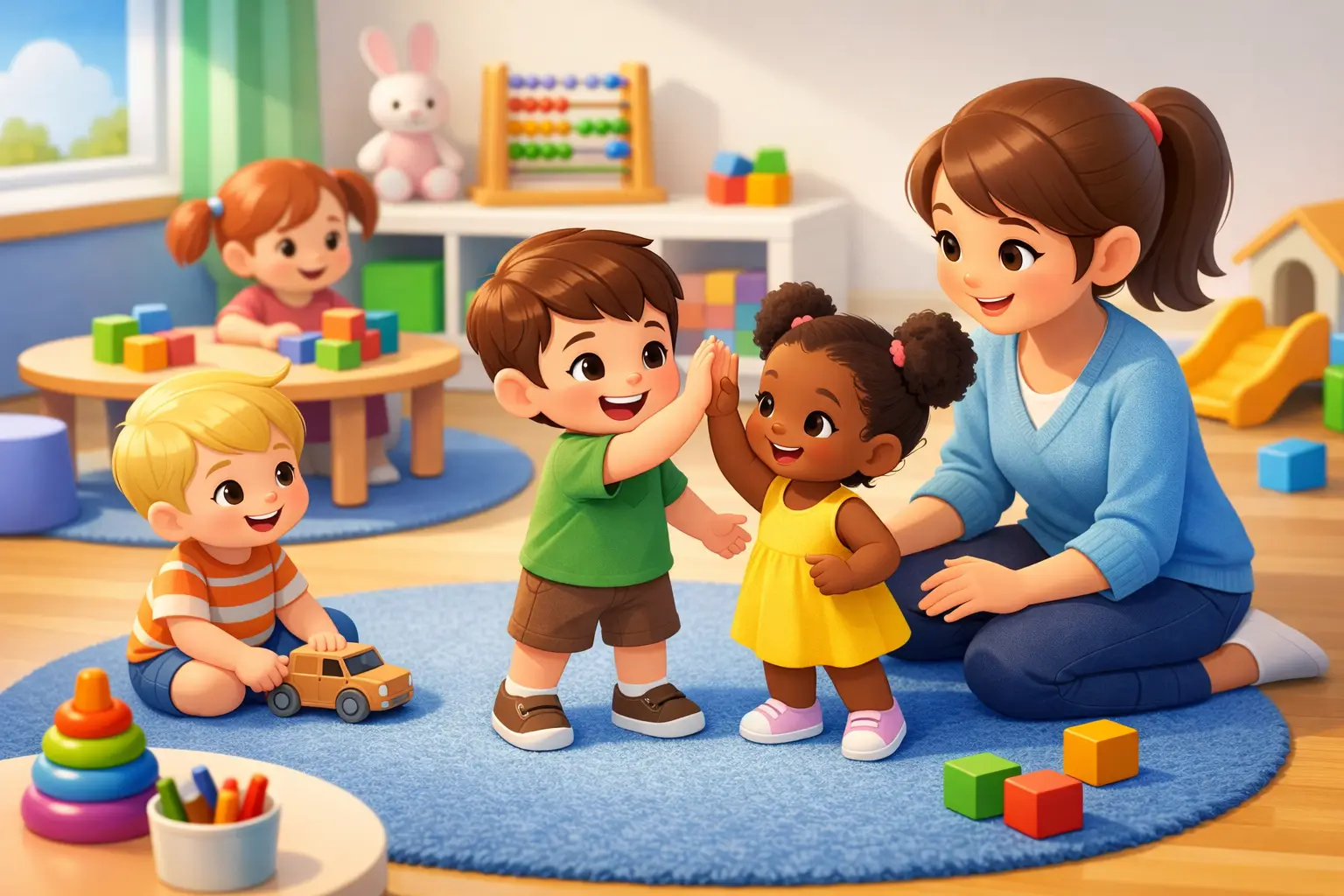
A child who watches quietly from the doorway on Monday may be offering a toy to a friend by Friday. These small moments are meaningful. Child socialization at nursery is not about expecting young children to be instantly outgoing. It is about giving them gentle, repeated opportunities to feel safe with caring adults, notice other children, communicate their needs, and discover the joy of belonging to a group.
For families, especially when a child is beginning nursery for the first time, this growth can feel both exciting and emotional. A nurturing early-years setting helps children build social confidence at their own pace while reassuring parents that every interaction is guided with patience, care, and attention.
What Child Socialization at Nursery Really Means
Socialization begins long before children are ready to say, “Can I play?” For babies, it may look like making eye contact with a familiar educator, smiling at another baby during floor play, or learning that their cries will be answered kindly. For toddlers, it often includes playing alongside peers, copying words and actions, and beginning to understand simple routines such as waiting for a turn.
As children grow, social learning becomes more collaborative. Preschoolers start joining group activities, sharing materials with support, using language to solve small disagreements, and recognizing how their actions affect others. None of these skills appear all at once. They grow through everyday experiences that are predictable, warm, and appropriately guided.
At nursery, children also learn that they can feel secure away from home. This does not replace a parent’s role. Instead, a trusted educator becomes another caring adult who helps a child move confidently between home and a wider community.
Why Peer Experiences Matter in the Early Years
Young children learn a great deal by watching one another. A baby may become interested in shaking a musical instrument after seeing another child do it. A toddler may try a new word after hearing it during play. An older preschooler may learn to take turns when building a tower because the activity only works when everyone has a place.
These experiences support communication, emotional awareness, independence, and early problem-solving. They also give children practice with feelings that are common in group settings: excitement, frustration, curiosity, disappointment, and pride. When an educator calmly names those feelings and helps a child respond, the child begins to develop skills they can carry into school and family life.
Socialization is not the same as constant group play. Children need quiet moments, one-to-one comfort, and the freedom to observe before they join in. A well-planned nursery day balances active play with rest, small-group experiences, routines, outdoor movement when appropriate, and calm transitions. This balance is particularly helpful for children who are naturally cautious or still adjusting to a new environment.
Social Learning Looks Different at Every Age
For the youngest children, a responsive relationship comes first. In a BabyStar classroom, consistent routines for feeding, sleeping, cuddles, songs, and sensory play help infants feel safe. That sense of security is the foundation for noticing people and exploring the world around them.
Toddlers in a Tiny Cubs stage are often eager to explore but still need close support with big feelings. They may play beside another child rather than directly with them, which is a normal and valuable part of development. Educators can encourage simple exchanges by modeling phrases such as “my turn,” “all done,” and “can I have it?”
Tweenies and Biggies children are increasingly ready for cooperative experiences. They may help tidy up, participate in circle time, choose a role in pretend play, or work with friends on a creative activity. These moments support confidence without placing pressure on children to perform socially before they are ready.
The Educator’s Role in Building Kindness and Confidence
Children do not learn social skills simply by being placed in a room together. They benefit from educators who notice each child, understand age-appropriate behavior, and guide interactions with a calm, respectful approach.
For example, when two toddlers want the same truck, an educator can keep everyone safe while helping them learn from the moment. Rather than labeling either child as naughty, they might acknowledge the feeling: “You both want the truck. It is hard to wait.” Then they can offer a clear next step, such as taking turns with support or finding another appealing vehicle. Repeated experiences like this teach children that feelings are acceptable and that there are kind ways to respond.
Educators also create opportunities for connection through songs, shared stories, movement games, sensory activities, and simple classroom jobs. A child who is hesitant to speak in a large group may feel comfortable handing out crayons or sitting near an educator during a story. Confidence often develops through these small successes, not through pressure to be the loudest child in the room.
A professional team is especially important during transitions. The first days of nursery, moving into a new classroom, or welcoming a new sibling can all affect a child’s behavior. Sensitive educators communicate with families, observe changes, and offer the extra reassurance a child may need.
How a Safe Environment Supports Social Growth
Children are more likely to explore and connect when they feel physically and emotionally safe. Clean classrooms, age-appropriate equipment, clear routines, secure arrival and departure procedures, and attentive supervision allow children to focus on play and learning.
Emotional safety matters just as much. Children need to know that an adult will help if they feel upset, that their attempts to communicate will be heard, and that mistakes are part of learning. When a child knocks over a block tower or struggles to join a game, a supportive response helps them try again.
A home-like atmosphere can make a real difference, particularly for children who are still developing separation confidence. Familiar routines, welcoming spaces, and caring greetings help create the sense that nursery is a place where they are known and valued.
What Parents May Notice at Home
The benefits of nursery socialization are often visible in ordinary family moments. Your child may begin talking about another child, singing a new song, pretending to be an educator, or using words such as “wait,” “help,” and “mine.” They may also start showing more independence, perhaps trying to put away toys or wanting to do a small task without assistance.
Some changes can be less straightforward. A child may be tired after a busy day, more sensitive during the adjustment period, or begin testing boundaries at home as they process new experiences. This does not automatically mean nursery is not working. Young children often need time to adapt to the social and emotional demands of a group setting.
Keep communication open with your child’s educators. Share changes at home, ask how your child settles during the day, and let the team know about comfort items, family routines, or words your child uses for important needs. Consistency between home and nursery can make transitions easier.
Choosing a Nursery That Nurtures Social Development
When visiting a nursery, look beyond whether children are busy. Notice how adults speak to them. Are educators down at the child’s level? Do they comfort children promptly? Are activities suited to different ages and abilities? Is there room for children to play together as well as space for calm, individual exploration?
It is also helpful to ask how the nursery supports children during the settling-in period and how families receive updates about daily experiences and developmental progress. Social confidence grows best when parents and educators work as partners.
At CESK Pre-school, age-based classrooms are designed to support children from their earliest months through preschool readiness. Through caring relationships, guided play, and developmentally appropriate routines, children have opportunities to play, learn, and grow together in a secure setting.
Every child has their own social rhythm. Give your child time, celebrate the brave little steps, and trust that a caring nursery community can help those first hellos grow into confident friendships.